Thursday, April 18, 2019

Farintosh Farms Closing


 To all our wonderful customers,

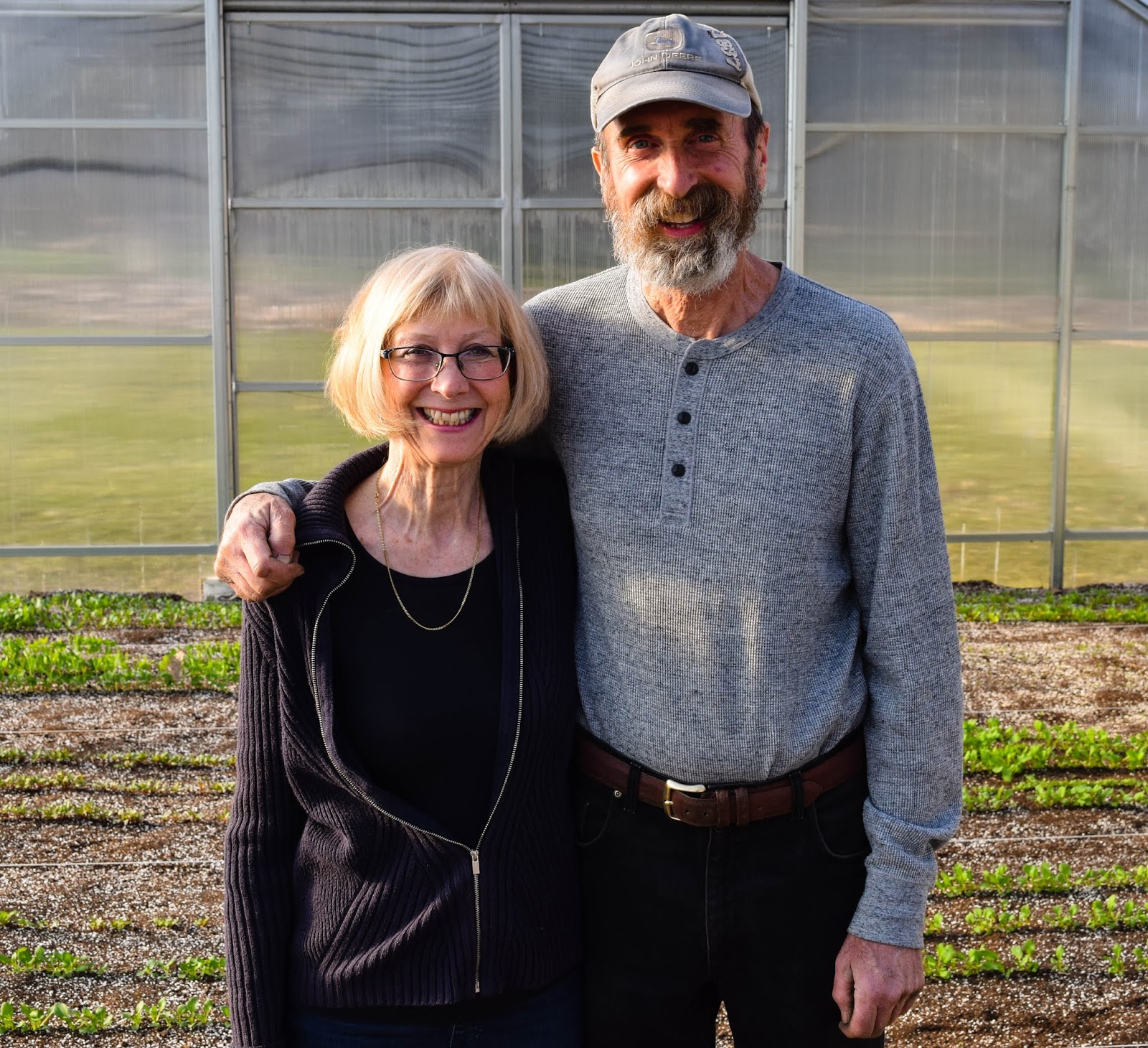
  After much deliberation and soul searching,  Karen and I have decided to retire from the market and Pick Your Own. Our farm will now be permanently closed to the public.

  The farm has not been sold, and I will continue to grow many crops for what I hope will be many years to come. We are  both looking forward to taking a break and undertaking some new challenges.

  Thanks to all those of you who have made that drive down our lane over the years, allowing us to be a small part of your meals at some point.

  Thanks to our neighbors, local golf club customers, cousins and weekly sweet corn customers from the city. Eric, Rob, Louise, Patrick, the Wells family, Derrick, Alice, Min, Lisa, Gary...... it's a long, long list, started by Mrs. Gwen Smith who has been a loyal customer for each of our 46 years in business.

  Major respect and a huge thank you to the West Indian community, especially our Jamaican customers. Your unwavering loyalty and easygoing good humor made our dealings with you an absolute delight and a whole lot of fun.

  We have progressed from hellos through handshakes to hugs with many, many of you and our lives are infinitely richer for those wonderful human connections. We will certainly miss you all.

  We could not have farmed without our hard working field and market help. Thank you, Darryl from Newfoundland, Clifford and Keroy from Jamaica, Cassandra, Chloe, Bob Knapp and my mother, who loved to transplant our veggies. Thanks to our son Geoff, who wore both hats without complaint over the years.

  A huge thank you to our longtime friends Murray Empringham and Arthur Schickedanz and their capable crews for being the world's best neighbors.

  It takes a village to supply a farm. Thanks too to our many suppliers including the friendly crew working with Terry Reesor at Reesor Seed and Grain,  with Brent at FS Partners in Alliston and Rob Hovius at Stokes Seeds.

  The last thank you goes to my father, who facilitated and inspired this city kid to be a farmer when he grew up. I have surely led a charmed life to have had so much fun doing what I love, all the while feeling that it made a difference.

  Our farmstead and crops have been (and will continue to be) a source of pride to us over the years. We are deeply humbled and honored that you noticed and that you cared enough to keep coming back to support our local farm family.

  Sincerely,

  Guy and Karen Farintosh


Sunday, December 31, 2017

2017: A fairy tale season


Cinderella season: A situation in which competitors achieve greater success than would reasonably be expected.

  The winter of 2017- 2018 is quickly turning into one of the coldest on record.  It is -23 degrees Celsius here at the farm as I write this , yet another in a week long string of record-breaking cold days.

  December 28th was colder in Toronto (-22 degrees C.) than at the North Pole, where Santa was basking in balmy -18 degrees C. warmth.

  It wasn't supposed to be this way. Environment Canada's senior climatologist Dave Philips, who forecast a milder than usual winter, has already (after 10 days of winter!) issued a mea culpa:

   "Egg on my face is something I deal with a lot", he said in an article in the Dec. 28, 2017 issue of the Toronto Star.

  It is still early days, and we can only hope that Mr. Philips is right in the long term.

   I' m not sure why we have such a fascination with long range weather forecasts, but one thing is for sure: the word "normal" no longer applies. Several long range prognosticators hedged their bets for the 2017 growing season and said that it would be a "normal" year.

  The evidence to the contrary can be bench marked by four different T.V. and newspaper stories about the farm in 2017. Three of the four stories occurred largely due to or only because of the abnormal weather that we were experiencing. A look back:

  By the June 1st we were already two weeks behind due to a wet, cold spring. Anwar Knight, from CTV weather came early one morning to talk about the unusual spring and how it was affecting us.

  Anwar asks great questions and is extremely kind about listening to my answers. It can be tough for farmers to get our message out when we are busy, so my hat is off to him for doing just that. A wonderful envoy and genuine nice guy:

  https://www.facebook.com/ctvtoronto/videos/10155365214804579/

  By August 1st, we were not only two weeks behind, but our fields continued to be covered in water from relentless heavy rains. Our local newspaper had a monthly supplement in August with the headline: "Special Report, The Rains of 2017" with a picture of an odd looking local farmer taken in a brief moment of sunshine on an otherwise cloudy day.

   David Tuley, Stouffville's  economic development officer, who understands the importance of farming to the area was the impetus behind this supplement. He is another delightful man to work with:

http://www.townofws.ca/en/town-hall/resources/Documents/OnTheRoad/OnTheRoad_Aug17_WebEdition.pdf

  On September 1st, the temperature in the morning was 5 degrees Celsius, which did not bode well for a late frost (i.e. later in October.) Every farmer in Southern Ontario watched and waited for Mother Nature to deal the cards for September.....

  Most of us got four aces. If ever the word "miracle" could be applied to a month in 2017, September was that month. I keep a daily journal, which includes a description of the weather. In the sixteen days between September 12th and September 27th, the word "sunny" appears sixteen times, along with daily highs in the high twenties or low thirties.

  On September 26th, CBC news stopped by to do a story on how all the hot, dry weather was negatively affecting farmers. We had some damage, mostly due to sun scald on our vegetables, but I  pointed out that all the hot, dry weather had indeed saved our season. The loss of a percentage of some crops was collateral damage that we could live with.

  The interview was on radio and T.V., but the only record I have of it is online. A tip of the hat to CBC for taking farmers' concerns to a broader audience:

  http://www.cbc.ca/news/canada/toronto/heat-crops-vegetables-fruit-farms-1.4308188

  On October 2nd, CITY T.V. stopped by dark and early to do several segments at our farm to kick off  Agriculture week In Ontario. Our Pick Your Own fields were in full on mellow fruitfulness mode.

  The season that looked like a train wreck a month before had turned into a first class ticket on the Orient Express.

  Many thanks to Kelly Ward of the Ontario Minsitry of Agriculture and Food and our neighbor and friend Cathy Bartolic of Ontario Farm Fresh for  submitting our name for the Breakfast Television piece. Both are wonderful ladies to work with and obviously focused on getting the farm fresh message out there. It was a lot of fun and a great source of publicity for our farm:

  https://www.facebook.com/FarintoshFarms/videos/1447903995325342/

   It was a fairy tale season all right: part Cinderella story and part Goldilocks.

  2017 wound up being our best ever year on the farm, a fact that still amazes me. We feel extremely blessed and grateful for the fortuitous change in the weather and humbled by the magnanimity of a kind and long-suffering God, who had his hands full in 2017.

  A huge thank you to all of our loyal customers, who stood by us and waited until those vegetables were finally ready. It was a compressed selling and picking season that demanded a large helping of patience on your part. You didn't disappoint us.

  We wish each and everyone of you a healthy, happy 2018 that is memorable for all the right reasons.

  And, dare I say, a normal growing season.

  Guy

Friday, October 20, 2017

Small is Beautiful


"Enjoy the little things, for one day you may look back and realize they were the big things."
                                                  Richard  Brault
                                  
  Fall is the season of horticultural superlatives.There is a real thrill for farmers and gardeners everywhere to finally harvest those dinner plate sized dahlias or pickup bed sized pumpkins.

  Clifford and Keroy take particular pleasure in finding the biggest/ heaviest/ largest of any vegetable  that we grow. One pound peppers. Fifteen pound cabbages. Thirty-five pound watermelons. It is like the mother of all Easter egg hunts for us.

  The fly in the ointment can be to actually sell these monsters. It may take a village to breed, develop, sell the seed and grow it to harvest, but not everyone needs a single vegetable that will feed a village.

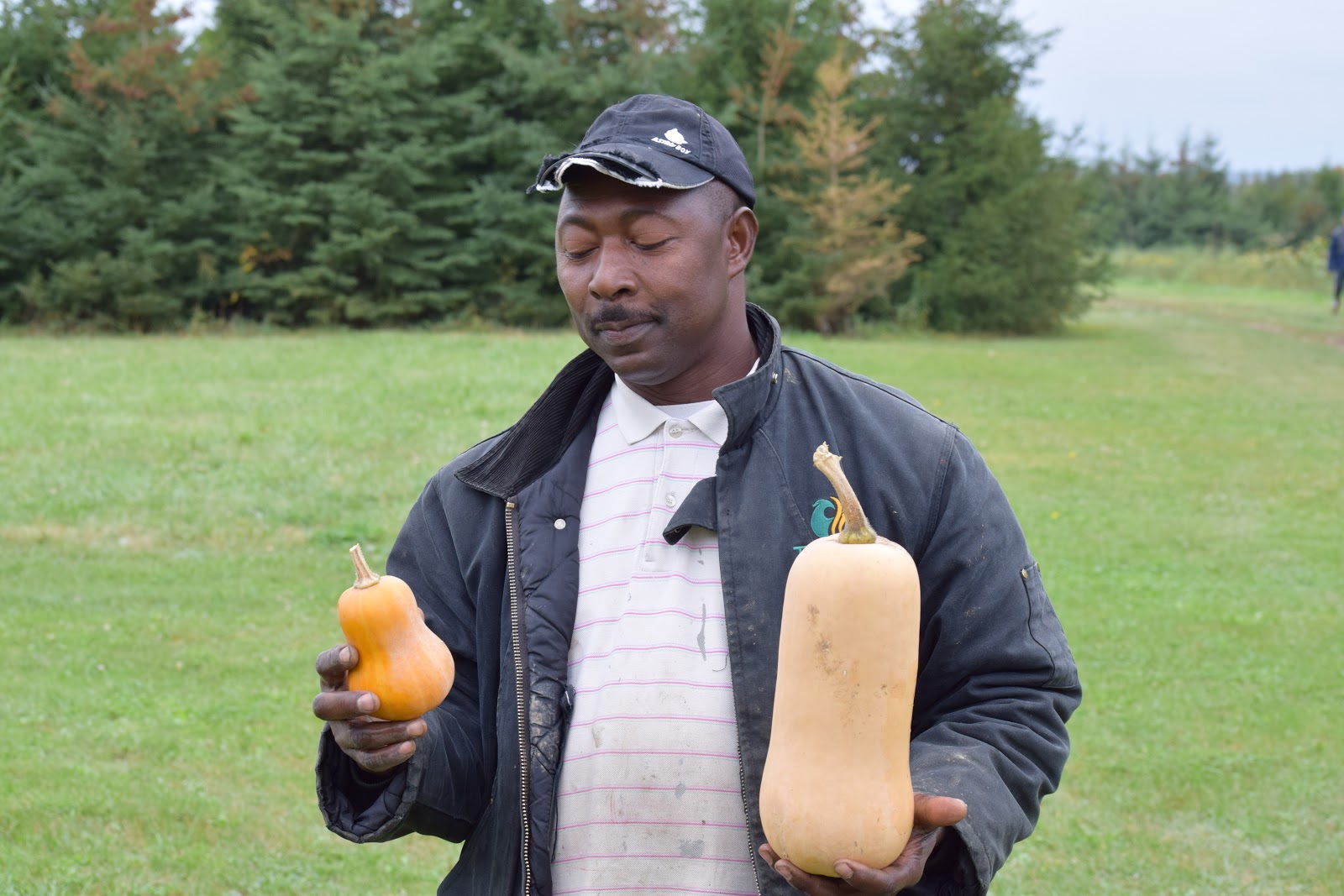
  We have grown Ultra HP, a variety of butternut squash for years. It attains impressive size, maturing to ten to fifteen pound sized monsters. Clifford and Keroy loved harvesting it, and outdid each other looking for the biggest specimens.

  They had grown more difficult to sell in recent years, so I dropped them from the starting lineup and looked for a more family-friendly butternut squash. Honeynut is the name of one of the new varieties that we trial planted last year.

  Clifford brought in the first bushel of them from the field in mid September of 2016, with a look of disgust written on his face.

  "These squash are wimps, mon!"

   (Clifford always ratchets up the decibels to emphasize certain words that he feels strongly about.)

  It was true. Inside the bushel was a collection of the smallest buttercup squash that we had ever grown, about a pound each.

  That first day, we gave some away, sold others and took a couple to try ourselves.

  They were and are, without a doubt, the sweetest and most delicious squash that we had ever eaten, and we have eaten a lot over the years. Anyone who tried them was back for more and we very quickly sold out.

 I have always been a buttercup squash guy, but these were good enough to get me to change my religion.

  Honeynut squash, as it turns out, is a cross between butternut and buttercup squash, thanks to the efforts of plant breeders at Cornell University. Before you ask: this was developed through good old-fashioned plant breeding and is not a GMO variety.

  Michael Mazourek, an assistant professor in plant breeding at Cornell since 2008 has spearheaded a move towards breeding better tasting vegetables rather than better shipping ones. The ultimate goal is to get people to eat more nutritious food by developing better tasting food.

  Honeynut squash, with its deep orange flesh, is packed with beta-carotene. The flavor appears to be maximized by roasting it until it caramelizes rather than steaming it.

  Don't forget to pick up a few to try and to add "sweetest", "tastiest" and "healthiest" to your list of fall superlatives.

  Guy


Saturday, September 9, 2017

Pick Your Own Stories


"Why can't we drive our cars out to the fields anymore?"

      ~Question asked at our Pick Your Own from 2012 to the present.

  The glory days for the Pick Your Own fruit and vegetable business in Ontario were surely during the 1970's, '80's and '90's.

  Families tended to be larger then and we had a committed group of regular customers who picked and preserved large quantities of fresh vegetables. A number of PYO farms flourished in our area to cater to their needs.

   In order to accommodate the larger orders, we allowed people to drive their cars out to the fields to pick their own vegetables.

   People either kept track of the number of a certain vegetable that they had picked (corn, eggplant or squash) or bushels and baskets were assigned to sell other items by volume (tomatoes, peppers, beans, cucumbers, etc.)

   Every morning , beginning at our 8 a.m.opening, I would direct my customers to different fields on the farm. They would return in time with neatly counted bags of corn and level baskets of produce.

  It was surely the most simple of business models.

  The reality was strikingly different for many reasons, the first being the notion of an 8 a.m..opening.  This was like sleeping in until noon for many pickers.

  Opening day for squash picking was a case in point. The first customers would arrive in the dark at about 5 a.m, armed with miner's head lights and flashlights. The idea was for the early bird to catch the largest squash, which we sold by the piece, lowering the price as the squash got smaller throughout the day.

  One memorable year, it was raining for our squash opening, so I was short staffed (i.e., alone), figuring turnout would be light.

  There were seventy cars in the field before our 8 a.m. opening;  over one hundred by 9 a.m.

  Which prompts a discussion of the second reality of the business: short term memory loss.

  The vast majority of our customers were absolutely honest and a pleasure to deal with. There was another group, however that made me feel like the gatekeeper of an early onset farm. The memory of the number of corn and squash in certain customers' car trunks was vague at  best and larcenous at worst, which meant that we had to count or measure every piece of produce in the car.

  One memorable customer rolled up to our checkout with the front of  his clapped out Toyota Corolla inclined at a thirty degree angle and "about five dozen" corn in his trunk. Fifty seven dozen was the final count.

  Another woman checked in as a short lady and left two hours later a foot taller than her husband. Further investigation under some suspiciously lumpy seat coverings revealed that all the back car seats had been taken out and replaced with produce.

  Her front passenger seat had become a veritable vegetable tower with layer upon layer of produce stowed away. Even her purse was bulging at the seams with shelled Romano beans.

  Their guesstimate of "about twenty dollars" worth of vegetables that they did choose to show us in their trunk grew to an actual one hundred and sixty after we had pulled the car apart.

  Other customers offered a vegetable medley in their car trunks. These were often big ol' Detroit sedans with massive trunks and large spare tire wells, into which hundreds of pounds of  unorganized and uncounted vegetables reposed. Or worse: station wagons and vans.

  "Give me a price, Guy!', was the usual request, which is a little like guessing how many dollars worth of guppies are in an aquarium.

  Mother Teresa would have been talking to herself after a day of this. Henry Kissinger would have been in therapy.

  Certain customers were repeat offenders and clearly loved the cat and mouse game of  hiding produce all over the vehicle.

  One such customer rolled in early one morning just as it was getting light.

  His visit happened to coincide with the rather nasty breakup of our tenants in the house immediately beside the PYO check in.

  Long story short: Girl meets guy. Guy goes to Milhaven penitentiary for a year. Guy is released. Girl breaks up with guy who takes it badly. Guy takes girl's SUV out in our fields and runs into every tree and rock he can find. Girl calls police. SWAT team shows up, but guy is gone.

  Our customer's visit just happened to coincide with the return of the SWAT team to their vehicles in our parking lot. They were dressed in full on SWAT gear and had many various weapons and riot gear cradled in their arms.

  The customer looked at me in alarm and asked, not surprisingly:

  "What's going on here?!!."

  It was too good an opportunity to pass up. As casually as I could manage, I said:

  "Oh, we are really checking trunks out today!"

  It was a fib, of course, but the look of abject horror on his face was so worth it.

  He came back an hour later with his vegetables laid out like a church supper.

  We still joke about it and, amazingly,  he still asks the question at the top of this blog.


  Future blog: Pick Your Own Stories 2: Love in a Dangerous Place.

  Until then,
  Best,

   Guy


Friday, June 23, 2017

Too much of a good thing


Summer 2016:  " I guess you farmers could really use some rain!?"

Summer 2017:   "I guess you farmers are really loving all this rain!?"

  I slogged back to the house early this morning after dumping another inch of rainfall that had fallen overnight out of the rain gauge. Rainfall sheeted down with biblical intensity from a sky that roiled like diesel exhaust overhead.

  A check on the computer weather forecast informed me that Gormley was currently experiencing "light thunderstorms".

  I have never heard the word "light" coupled with thunderstorms before, but I guess that it's kind of like light beer: a marketing gimmick designed to make you feel better about quaffing beers.

  Sure enough, the rain gauge showed another inch of rainfall in the gauge by 9:00 a.m., but I didn't feel so bad because they were light thunderstorms.

  Clifford and Keroy, our two Jamaican farm workers and I spent the rest of the morning in  Stouffville, getting in grocery shopping early for a change. Too wet to do any farm work.

  Apart from a few puddles, there was very little evidence that it had rained heavily in Stouffville at all, although they had experienced similar rainfall. Urban environments, with their pavement, lawns and storm drains are designed to quickly and efficiently deal with excess water.

  The difference is that the two inches of rain that fell on our 150 acre main farm in the last 24 hours is over 30 million liters of water. While there are two watercourses, the vast majority of that rainfall has to percolate down through already sodden soil.

  We will have to wait three to four days to even consider getting back on the land without damaging it by working it too wet.

  Vegetable farmers rely on succession plantings to ensure a continuous supply of corn, beans, lettuce, and cole crops throughout the summer. Ideally we would like to plant sweet corn every three days, beans, etc., every seven days.

  The challenge of doing so in the spring and early summer of 2017 has been considerable, given that we had about five days to work the land in May and about seven good days so far in June.

  We are fortunate to have some well drained land that has been planted and will continue our succession plantings until mid-July, so we will be back in business soon. Sweet corn and beans will be later this year, likely the first week of August.

  God willing and the crick don't rise....

  Guy


Sunday, January 22, 2017

Jessie


  " You have to come and see this dog, she looks just like Rachel."

  It was my wife's third call from the pet store in the past half hour with the same message.

  The truth was, I didn't feel that Rachel could be replaced. She had been part of our lives until September 11, 2001 (yes, that September 11) when she jumped out of the back of my truck, landed awkwardly and broke her leg. The vet said that, at 14, she was too old and feeble to rehabilitate. We had to have her put down.

  Reluctantly, I drove to the mall and found my wife, son and Rachel's doppelganger.

  In a room populated with smaller, cuter puppies stood this gangly hound with feet that were three sizes too big for  her body. Her body was three sizes too big for her crate, which was euphemistically labelled "Pointer Cross." The original asking price had dropped to one hundred dollars from three hundred.

  And so, from a pet store in the middle of the city, Jessie came to us and our farm.

  To say that Jessie embraced life on the farm would be an understatement. She had the run of the place, which was Big Rock Candy Mountain for that dog, who brought a manic, unhinged joy to each and every day that she spent there. Her glass wasn't merely half-full; it overflowed.

  Whatever you were doing was just what she felt like doing. She was hard wired to the throttle of any farm vehicle, no matter where and how long the job. Her personal favorite time of year was during sweet corn harvest, when she had a 25 acre buffet to graze selectively.

  She wasn't beyond a little devilment: ambushing my son's soccer ball in a high speed run by assault, or snatching the odd carrot from the counter at the market. We marveled at her easy athleticism and stamina.

  Jessie's presence at our market was a calculated risk. Some people, especially children, are afraid of dogs, fearing that they will be bitten

  Jessie put in long days at the market working assiduously to tear down this belief using her own method of dogged diplomacy.

  Rather than going right up to the stricken child, she would find her tennis ball, which she would then drop in such a way so that it would roll up to their feet. Jessie would position herself in front of them, about eight feet back, sitting in a non threatening position. From there, she would see if this particular kid could put two and two together.

  Most did. Parents would constantly be amazed that, in short order, their formerly terror stricken child would be joyously throwing a dog-drool soaked tennis ball and having it returned to them.

  We have a large graduating class of young adults who now tell us: "I no longer am afraid of dogs because of Jessie."

  Jessie had slowed down over the past couple of years, her eyesight and hearing both diminished. I turned her out early one morning as usual this past September. She came back dazed and badly torn up, having been blindsided by a coyote in the dark. Despite a round of antibiotics and treatment, she never really recovered her health and her former zest for life.

  In the end, it was her legs that finally failed. Those marvelous limbs that had propelled her over thousands of miles were unable to lift her frail body any longer.

  We spend a lot of time and energy in our lives looking for "the one." Sometimes, with luck, we get it right.

   It is my experience that dogs are, invariably, "the one." Dogs don't fall out of love over time. Rather, they define love, work hard at it and embrace us, imperfect as we are, to make the absolute best of our short time together.

  Although my life is poorer for having lost Jessie, it is infinitely richer for having known her.

  Guy


Thursday, October 20, 2016

International Harvester 1, Honda 0.


"DIDN'T YOU HEAR ME HONKING!!!!"
        Young lady who had just sideswiped my tractor drawn plow.

  Your mission: Venture out on any reasonably busy GTA road in your car. Rules of the road are to be obeyed. You will be given one hour and a dashboard camera. You will record any egregious traffic violations by other drivers: speeders, texters, road-ragers, non-signallers and the like.

  The task is sadly, laughably simple. On most days, a highlight reel could be compiled long before the hour was up.

  Now, let's change the rules. Instead of a car, you will be driving a tractor. A tractor pulling an implement that is wider than the lane you are in (wider than 12 feet).

  You cannot travel at the speed limit, because most tractors cannot travel that fast, therefore your speed will be limited to 20 km./hour.

  After an hour, you will be driving on the gravel shoulder, because your highlight reel is getting too heavily weighted towards one-fingered salutes.

  Your audio track will consist mainly of Country and Western music and the sound of your breath being quickly sucked in between your teeth as yet another late-for-tee-off-time kamikaze passes you with inches to spare and narrowly avoids being rebadged as a Peterbilt.

  And, every once in a while, sadly, it will change from being a spectator sport to a contact sport.

  That was my experience in early October of last year. The day was perfect, sunny and bright. Traffic was light at 10 a.m. as planned. Most farmers avoid rush hour travel if at all possible. I was pulling a four furrow plow drawn by a large tractor with a cab.

  Part of the route between our two farms involves travel along 19th. Avenue in Markham, a road designed for 1960's (lighter) traffic and (smaller) implement sizes. Road shoulders are tiny to non-existent between Warden Ave. and Kennedy Road.

  The choke point is a narrow bridge that used to be single lane, but was  given two lane stature by an
optimistic road painter when the road was paved. An unwritten first-in-first-out rule has existed for as long as I can remember for any wide vehicles approaching from either side.

  Imagine my surprise when the quickly closing oncoming Honda made no attempt to slow down or yield to my much larger tractor, despite the fact that I had already traveled more that half way along the bridge.

  I'll give the International Harvester plow credit for being well named. That plow effortlessly harvested the driver's side mirror and windshield molding and struck out a nice furrow along the door. The donor car was a brand new Honda Civic, still in the dealer wrap on its way to a new car buyer.

  The young lady got out of the car furious at me. I would add the adjective "lucky" to her, although she probably wouldn't agree.

  The spine of that plow that struck her car is fabricated of a six by ten inch tube of 3/8 inch steel. It is pulled at a roughly 45 degree angle to the direction of travel. This allowed the Honda to be deflected to the side of the road, rather than the plow demolishing the driver's side of the car.

  Let me put it this way: In the counter intuitive game of Rock-Paper-Scissors, paper can "beat" rock because it is able to cover it.

  In the real life game of Plow-Airbag-Scissors, airbag may cover plow, but that won't stop plow from heading  through your vehicle and right on down the road  if the speed is great enough. Mercifully, in my accident, both vehicles had slowed down enough to make the crash a low impact event.

  Could I hear her horn? No, and really what difference would it have made?  That is a "horn" icon on your steering wheel, not a "vaporize" one.

  The policeman who showed up on her insistence was a picture of diplomacy and a credit to the York Regional Force. He advised her to slow down and reminded her that the signs posted on rural roads advise one to "Share the Road", not "Own the Road".

  He expressed concern about the state of my plow, after seeing the car. I was unable to find any damage at all to it beyond a quarter-sized patch of non matching paint.

  There were no charges laid against me, but, through the no-fault insurance laws neither were there any laid against her. I hope she learned from the experience.

  I am sure that anyone who is reading this is a terrific driver. However, I would like to remind you that May-June and September through November are busy times for farm machinery on rural roads.

   Driving at speed for awhile on a 400 series highway makes one comfortable with travel at 110 kph, so that first meeting with a 20 kph tractor or combine can be memorable.

   Just make sure that encounter is safe as well.

   Guy


Saturday, September 17, 2016

Sign of the Times


 I had a Gordie Howe hat trick at the market yesterday:

  A goal, an assist and a fight.

  We met our goal of selling all the sweet corn we had picked that morning. I assisted a lady who had locked her keys in her car. I also had a discussion with a man and agreed to disagree about our allegedly high prices.

  Anyone who runs their own small business will have an unwanted familiarity with certain customers kvetching about prices.

  Big business is protected by many layers of staff from complaints. The clerk at Petro Canada doesn't give a fig about the disconnect between the price of West Texas crude and the pump price, so no one bothers unloading on them. You might as well argue with the gas pump.

  However, when someone spots the price maker in their cross-hairs, things can get heated.

  In my own case, our price for squash is ten cents higher than last year. The customer suggested that there should be no increase due to lower fuel prices, which represent about five per cent of my costs. He parted with the argument that the increased use of food banks was all the proof he needed of extortionately high food prices in Ontario.

  A little context......

  In 1962, my father bought a fifty acre farm in North Markham Township with a partner for $24,000.
After closing, the partner got cold feet and wanted his share back. My dad paid him and left the "For Sale" sign posted.

  No one called. Not a single offer for five years, until, in 1967, he got an offer for $27,000, which he accepted.

  An apples-to-apples fifty acre farm across the road just sold last year for $2,700,000; a price one hundred times greater than the 1967 price.

  There is a sign up on the wall in our market dating from the mid 1960's. I found it while demolishing an old drive shed on Elmer Harding's farm at Birchmount Road and Steeles Avenue. The farm has long since been blanketed by housing.

  "Sweet Corn 35 cents per dozen. $ 1.00 for 3 dozen"

  It is, of course, laughable cheap by today's standards and a lot of people joke about buying our corn for that price.

  Let's assume for a moment that sweet corn at 35 cents per dozen had seen an increase similar to that of raw land. That would make the 2016 sign read:

  "Sweet Corn $35 per dozen. $ 100 dollars for 3 dozen.

  I am not the first person to make the case for the fact that the higher price of food that is not leading to increased food bank use as much as it is the exponential rise in the price of housing. My argument is an oversimplification but it merits some consideration.

  In 1969, about 20 per cent of the average consumer's take home pay went for food. That figure in 2016 is about 10 per cent. Even the poorest one-fifth of Canada's population spends about 14 per cent on food, less than half the 30 per cent they spend on accommodation.(Terry Daynard; blog, Jan. 10, 2016)

  Meanwhile, the price for a detached home in Toronto has reached million dollar territory, making the dream of actually owning such a house unattainable for most home buyers. Those high prices may not last, but, realistically, how much would they fall in the event of a correction?

  Food in Canada ( unless you live in the far north) is still a bargain, and the fact that we live in a country where food is safe, fresh and widely available means that most Canadians have already won the global food lottery.

  Keeping his stick on the ice,

  Guy

  P.S. Using that 100 multiplier for gasoline means that an Imperial gallon of gas that sold in 1969 for 35 cents per gallon  (1 Imperial gallon= 4.54 litres) would now cost $7.70 per litre!


Saturday, September 10, 2016

Tomatoes


  " I have a love affair with tomatoes and corn. I remember them from my childhood. I only had them in the summer. They were extraordinary. "    

                                                                Alice Waters

  When I was maybe eight or nine, I was given a large, chocolate Easter bunny. It was covered in brightly coloured, garish tinfoil. It was one of the most beautiful objects that I had ever laid eyes on, much less owned.

  For a couple of weeks, that resplendent rabbit occupied a place of honour up on my bookshelf, beside the Hardy Boy books.

  Then, one afternoon, I couldn't stand it any longer. It was time to partake of all that chocolatey deliciousness.

 You know the rest of the story. The chocolate tasted like mud, which wouldn't have been so bad, except for the fact that the doggoned thing was hollow. It had all the soul of a gold digging Vegas showgirl.

  I got over the crappy rabbit and yet every winter, I get duped in the very same way by tomatoes.

  They look so delicious, so evocative of summers past and yet to come. But their taste is merely okay, a faint shadow of that of their country cousins who are still asleep in their seed packets.

  The saying goes that "the older we get, the more we appreciate the things that money can't buy."

  Amen to that. You sure as heck can't buy a decent tomato in Ontario for most of the year.

  If we evaluated tomato years as we do wine years, then I would have to say that 2013 was a terrible vintage; degraded by cool weather. 2014 was marginally better, but it was a late, short season due to another growing season of cool, wet weather. Ditto for 2015.

  Then along came 2016. Whatever the heat and drought of this past summer may have taken away in yield have been given back in taste. I don't ever remember better tasting tomatoes. This year the flavor is absolutely amazing, embodying  that perfect balance of sweetness and acidity.

   Tomatoes are loaded with Vitamins A and C, in addition to a host of other vitamins and minerals, but it is lycopene that is getting everyone excited about them these days.

  A growing body of clinical evidence has shown that lycopene (which gives tomatoes their rich, red colour) is one of the most powerful antioxidants around. This, in turn, gives them great potential as a cancer fighter, due to antioxidants' ability to protect the body from harmful free radicals.

  Tomatoes are one fruit that should not be refrigerated; their flavour will be ruined. Ditto to placing them in a sunny windowsill. The best bet is to place them on your kitchen counter out of direct sunlight. They will ripen just fine.

  We grow a wide range of beefsteak tomato varieties, in addition to a couple of yellow cultivars that have lower acid content and a wonderfully mild flavor.

There is also a whole soccer team's worth of cherry and grape tomato varieties that add terrific flavor and eye-catching colour to any meal.

  Our fields have been in legume cover crops for two years prior to planting tomatoes this year , which minimizes the disease and insect pressure on our crop and maximizes the nutritional benefits to you.

  So get them while you can, freshly picked in our market or by picking your own in our fields. It is a golden opportunity for you to eat your fill of tomatoes with soul!


  Best,

  Guy


Friday, September 2, 2016

Local Food and Foreign Workers


  One of the great ironies of growing local food is that much of the farm help required to grow it comes from thousands of miles away.

  Our 1857 farmhouse has seen two families of 10 children raised in it over the years. There was little need for outside hired help back in the day; one raised their own work force for the fields along with their own food for the table.

  Sadly, my wife and I are shirkers in this regard. We have but one son. Many of you have met Geoff during past summers, but he will be back at the University of Guelph this fall, working towards his Master's degree in Agriculture.

  Those halcyon days of large farm families living every quarter mile along the concession roads and an abundant supply of local farm workers are but a distant memory now. The growth of the Toronto area along with an abundance of higher paying jobs has left local farmers scrambling for help.

  It is not a new problem. The song "How Ya Gonna Keep 'em Down on the Farm (After They've Seen Paree?)  was written in 1919. Its lyrics highlight the concerns that returning World War I soldiers would not want to return to the farm after experiencing the city life and culture of places like Paris.

  The Temporary Foreign Worker Program was created 50 years ago to help address this shortfall in farm labor. Jamaica was the first country to enter into an agreement with the Government of Canada, administered by the wonderfully capable Foreign Agricultural Resource Management Services (F.A.R.M.S.)

  Jamaica has been joined by four other Caribbean countries and Mexico as source countries for the program. Last year, 17,648 workers came to Canada to help do farm jobs that Canadians could not or would not do.

  We have two Jamaican workers, Clifford and Keroy, that have been with us for a number of years.

  Keroy lives on his own small farm in the Blue Mountains of Jamaica, where he grows coffee and assorted fruit and vegetables. He has four children ranging in age from 8 to 24, along with a hard working wife to work the farm during the five months that he is with us.

  Keroy is the quintessence of "Jamaica, No Problem." He is able to see the funny side of any situation no matter how bleak it may be. He has an absolutely contagious laugh and a sunny disposition that elevates all our spirits.

  Clifford is more Type A serious and seriously driven to work hard. He lives in Kingston, not far from Tivoli Gardens, a notoriously crime ridden housing project, along with his girlfriend and two small children. Fond of parables and riddles, he has more street smarts than I would have in ten lifetimes.

  Clifford has an uncanny ability to anticipate what is required on the farm next, whether it be planting, harvesting or stocking the market. I am certain that he and Keroy could run the farm without me for most of the season.

  Clifford and Keroy's time away from home allows them to support their families in a way that would be difficult on Jamaican wages. Both men have been able to buy property, educate their children and operate businesses in Jamaica.

  They are an important part of our family from the end of May to the end of October every year, We would be unable to farm without their valuable hard work. Please take a moment, if you don't already know them, to say hello. They are an absolutely vital part of your local food meals.

  Guy


Friday, October 30, 2015

The Season of Re's


  "What do you do over the winter?"
                               Most frequently asked question at our farm.

  I found the answer to the above question while cleaning up our market the other day. Someone had left a reusable bag behind. It had dozens of words on both sides, all starting with "re".

  Winter is the season of  re's.....

   Reweld. The prefix "re" means "again" or "again and again". Any old piece of equipment covers both meanings, adding another "again" in the case of that cobbled together front mounted mower. It is similar to a Lancaster bomber in that it requires 25 hours of maintenance for every hour that it is operational.

  Reestablish. One of the ironies of growing and selling fresh produce is that (sometimes, Karen's edit) after a busy day of dispensing tips on how to best prepare and serve kohlrabi, Swiss chard and kale, we come in exhausted and order pizza. Time to reestablish healthy eating, walking the dog and getting to know my pillow a little better.

  Restore. I have a 1934 Ford pickup that has been in my shop for the last seven years. At my present rate of progress, it might be done by 2034. Time to get it back on the front burner.

  Renew, reconnect. We have forged many friendships at the market over the years. The problem is that it is tough to have much of a quality conversation in seven second bursts on a busy Saturday. We look forward to reconnecting with those friends during the more relaxed days of winter.

  Rejig, retry. Okay, so those eggplants that looked like tomatoes were a bad idea. Still, it's always fun to order new and different veggies from the seed catalogs over the winter to try next spring.

  Rejoice. 2015 was a very challenging year: a late May killing frost followed by a cool, wet June and a dry July and August. All this was followed by an absolutely miraculous warm to hot and just-enough-rainfall September. It ripened our crops to full maturity that looked like a lost cause in the last week of August. If every September was like the one of 2015, we would all want to be farmers. A cause for rejoicing, indeed.

  Remember. I was honored to be asked to say grace at my niece Heather's wedding reception a couple of years ago. The wedding was held in a barn, all beautifully appointed for the occasion. So, in keeping with the theme, I said a grace that was originally carved into the stone lintel of a barn, over a large doorway. It is original to the barn and its owner, and its sentiments are absolutely appropriate for this time of year. It reads:

                                                                      1863
                 When your barn is well fill'd all snug and secure
                   Be thankful to God and remember the poor.

  I hope that your barn is metaphorically well filled, snug and secure. We all have much to be thankful for living here in Canada. I hope we all take time to remember and do something for the poor and dispossessed around the world and right here at home.

  Guy


Friday, October 23, 2015

School of Hard Knocks


 " We shape our tools and then our tools shape us." 

             Marshall McLuhan

  We hand dig our garlic, beets, carrots and other root crops. A big piece of the harvest is a favourite garden fork that has a story of its own to tell......

  Dempsey Brothers Hardware Store was a Toronto landmark, located on the North-West corner of Yonge and Sheppard from 1860, until it was moved a few blocks north in 1996.

  My father, who was a builder, had his office a few houses to the west of Dempsey's and he was a frequent and enthusiastic customer. Mickey Dempsey sold my dad the usual hardware fare like paint, tools and nails but also my mom's kitchen pots, the family's foot-ware and my winter and summer wardrobe.

  Some of the clothing stock was pretty dated, to say the least, so it really wasn't a big surprise that I looked like an extra on a 1960 episode of "Leave it to Beaver" in the summer of 1969.

  One of the perks for my dad's loyalty was Mickey's very occasional permission to allow him up into the attic to select his choice of what we now call new old stock. The business had been sold to the Dempseys in the early 1920's, but a lot of stock must have been included in the sale.

  It was like entering a time capsule: racks of beautiful old skates still in the boxes, old unused shotgun shells, horse bits, bridles and hand tools in mint condition that hadn't seen the light of day for decades.

  On one visit, my dad came home with a garden fork, among other things. The fork was immaculate, still with the original label. It was to my tool collecting  father like finding a long forgotten Fender Telecaster would be to a guitar collector. It likely dates to the 1920's, and it is this fork that we enjoy using to this day.

  My father's care of his tools ventured deep into obsessive-compulsive territory. He had them stored in racks on a wall in a purpose built room, where they were to be returned after each use. They also had to be cleaned off and oiled if necessary. It was like an armory.

  The cardinal sin of tool use was to leave one outside. "It'll open up the handles!", my dad told me (repeatedly), meaning that the dew, or worse (for you), rain would immediately start the handles towards an irrevocable downwards spiral into decay.

  My young brain seemed to struggle with the notion of order and looking after tools. I remember helping my father one hot summer day to lay some hated patio slabs.

  My father went out for the afternoon. I characteristically forgot about putting the tools away and somehow day faded into twilight with a rousing game of "Kick-the-Can" going on with all the neighborhood kids.

  As I rounded the corner of the garage in full rebel yell after joyously kicking the can, my mind vaguely remembered a stiff garden rake that I had left laying on the ground somewhere close by.

  I do not know the terminal velocity of a rake whose tines are stepped on at speed, but I do know what it feels like to be a stunned mullet that has been dynamite fished, lying on the ground gasping for air.

  It certainly made an impression on me, one that I couldn't tell my dad about, but the overall effect was life altering. I started to pick up those tools and look after them, before they took care of me.

  And here it is, all these years later, and I think about how much I enjoy putting boiled linseed oil on the handles, sharpening the blades and oiling the steel  of those tools every fall before they get put away. It is, in a way, time spent with my dad.

  Which is a big part of why that garden fork lives on.

  Best,

  Guy


Friday, October 16, 2015

Why do we treat our soil like dirt?


    "Man, despite his artistic pretensions, his sophistication and his many accomplishments, owes his existence to a six inch layer of topsoil and the fact that it rains"

                                                              Anonymous

  My doctor craned his neck to get a look at what I was reading on my last visit to his office. It has become a bit of a ritual, and has led to some great discussions about Steve Jobs, Lawrence of Arabia, plagues or whatever else I happen to be reading about.

  "Dirt", he said. End of discussion.

   In fairness to him, he knew as much about dirt as I would about performing a frontal lobotomy.

  The book is indeed called "Dirt", by David Montgomery and despite its less than riveting title, it is a fascinating read. The overarching theme is that soil is our most important and essential natural resource. It is also our least appreciated and least valued. While we all know the price of gas or heating oil, we tend to forget that soil is a vitally important strategic resource as well.

  This is not news to most farmers. I went to a day long "Soilsmart" conference in Kitchener last winter that was well attended, with speakers from all over North America.

  This would have been a huge event in 1931, when one in three Canadians lived on a farm, However, this is 2015, and the number is one in forty six. A number that will continue to dwindle.

  What this means is that, like my doctor, most people don't have the foggiest notion of why soil is so important. We treat it as a cheap industrial commodity that is available in limitless supply.

  Sadly, this is not the case, and Mr. Montgomery provides many examples of why soil degradation has taken down countries and empires, including Iraq, Greece, China, Haiti, Iceland, The Roman Empire and others. It's a long list.

  He states "...world soil erosion now exceeds new soil production by as much as 23 billion tons per year. At this pace the world would literally run out of topsoil in little more than a century. It's like a bank account from which one spends and spends, but never deposits."

  This steady bleed has caused many farmers around the world to dramatically change how they treat their land. I have written another blog ( "Is your farm organic?") and I will write more in the future that I hope you will read  to further your understanding and appreciation of what many farmers, including me, are doing to arrest and reverse this decline.

  We have seen our soil organic matter levels increase over the past 30 years, due to cover cropping, long rotations, no-till planting, composting and other practices. These have provided tremendous advantages to us by increasing the water holding capacity of our soil, increasing microbial activity; even helping plants fight off disease.

  But the bottom line is what these practices provide to you and to society as a whole, and I will continue to hammer this point home over the years to come:

  Healthy Soil = Healthy Food = Healthy People

  Your local soil zealot,

  Guy


Friday, October 9, 2015

Farintosh's Squashes


 "Farinsquash"

   John Shales high school nickname for yours truly

  A bit prescient, was our John Shales. Little did he, or I realize how predominant a role squash was to play in my life.

  It wasn't by design or any plan on my part; just one of those random strokes of serendipity that all too infrequently falls into our lap.....

  The fall of 1977 was my first full year on the farm after graduating from Ontario Agricultural College. I had a fledgling pick your own enterprise that had just come face to face against a hard truth of marketing farm produce:

  It's a lot easier to grow produce than it is to sell it.

  I had a couple of long garden rows with a bumper crop of squash that had tempted few buyers. By late September, the end was nigh, unless I stored them in my non-existent storage room.

  Down the lane puttered an ancient, powder blue VW beetle. The driver was one Isilene Lunan, an older black woman with cats-eye glasses and an bottomless supply of good cheer.

  She was drawn to my squash field, where she picked a few and then asked for my help to pick some more.

  By the time we were done, that VW was on its knees; squash crammed into every available space. We settled up and she headed out the lane.

  Next day, Isilene was back for more squash. Again, we overloaded that bug. She was back twice more before the end of the season. I later found out that she had given the majority of her payload away to friends and family.

  "You know", she said, "I have a few friends that would like these. You should plant more next year."

  I was to be reminded of that day when I watched "Field of Dreams" years later, when that Iowa corn farmer was told to "build it and they will come."

  So, in 1978, I planted more squash and as Isilene had promised; they came. Not only in cars, but in pickup trucks and vans; all loaded with customers looking for my squash.

  I later found out that  Seventh Day Adventist and Pentecostal ladies are the gold standard of networking.

  This annual squash picking day grew to the point that, by the high water mark of 2008, thirty years later, we were growing 10 acres of squash for all those folks who kept coming every fall.

  It has turned into a reunion for both me and my loyal customers, one where I have seen small children grow up and have family of their own.

  Isilene Lunan retired to Jamaica, where she passed away several years ago.

  But her spirit is alive and well. The generosity of our customers continues to humble me every year. I am sure that more squash is given away than is consumed by them; to friends, family and older people who can no longer make the trip to the farm.

  Any squash that we have left over is taken to the food banks in Markham and Richmond Hill.

  Isilene would expect no less.

  Respectfully.

  Guy


Friday, October 2, 2015

Windbreaks


 "The best time to plant a tree is twenty years ago.
    The second best time is now."
                                                     Chinese Proverb

  Picture if you will, a newly planted vegetable seedling in a large open field. 

  It was transplanted into beautiful, loamy soil with ideal moisture conditions and a shot of water and starter fertilizer to settle it into its new home. The day is sunny and warm. Conditions are perfect.

  Most early mornings are relatively windless on our farm, but, by about 9:30 a.m. the wind has really picked up. The wind generally strengthens through the day, often hitting 60-70 clicks by afternoon. Visitors from the city often remark on how windy it is on the farm compared to the city they just left.

  Long before this speed has been attained, our happy little transplant is starting to undergo some serious stress. It is transpiring or losing moisture through its leaves more quickly than it can replace that water through its roots. Blowing soil damages the leaves as well.

  Left unchecked, wind will stunt the growth of those stressed transplants leaving them prone to insect damage and disease with a consequent reduction in final yield.

  This is where those windbreaks enter the picture.

  By planting rows of coniferous trees at 90 degrees to the prevailing wind, we are able to slow down the wind to a point where it is no longer damaging.

  The rule of thumb for protection from windbreaks is that: for every foot of tree height,
ten feet of field to the lee of the wind is protected.

  Our oldest windbreak is a triple row of Norway Spruce, planted in 1927 by a forward thinking Carl Reesor. It is now about 80 feet high, giving us roughly 800 feet of protection, which covers most of our farmstead buildings.

  It also shelters a 3 acre field where the benefits of a dense windbreak become most apparent.

  The microclimate that has been created to the lee of this windbreak is an almost unbelievable transformation: a virtually windless sanctuary that we refer to as "the banana belt". It is perfect for watermelon and other heat seeking crops that thrive in the lush, steamy sanctuary that it becomes every summer.

  I have added to this original windbreak over the years, planting 2000 conifers in 1984 and another 2000 trees in 2006. I used white cedar to the windward side, with a middle row of norway spruce and white spruce on the leeward side. I've also used white pine on some of the more sandy land.

  No wonder so many people ask me if we sell pick your own Christmas trees!

  My own experience is that the trees have grown about one foot per year. That assumes that you take care of them just like any field crop: our 2006 planting required extensive watering in the drought of 2007. We also weed around the trees and mow between the rows for the first 6-7 years.

  Practical people have pointed out to me that I'd better stick at the farming for awhile to take advantage of that latest planting.

  They're right, of course. I hope to do just that; after all, those fields are going to be more fun and easier to farm every year!

  Less gusty in Gormley,

  Guy

P.S. Our windbreaks will be part of a Conservation Authority Tour this coming Thursday October 8, 2015.

http://www.thelivingcity.org/dotAsset/211509.jpg

Check out the link, you may want to be part of an environmental farm tour to hear more details about our windbreaks and other farm initiatives:


Friday, September 25, 2015

In Praise of Mature Squash


  Question: (asked by me of a tiny 85 year-old woman who had just purchased a huge Hubbard squash)  "Do you need a hand to cut that into smaller pieces?"

  Answer:  "Oh my dear, no thank-you. I live on the eighth floor!"

We have grown and harvested hundreds of tonnes of squash over the past few decades including:

  Butternut Squash: The Alfa Romeo of squash that appears as though God was handed a french curve set. With its small seed cavity, it is easy to process. Terrific for baking or steaming.  Sublime in soup.

  Acorn or Pepper Squash: The Toyota Camry of squash that doesn't look anything like an acorn. Reliable and pleasant, although it can be stringy if unripe. Best baked with a dash of brown sugar. Early maturing.

  Hubbard Squash: The Hummer of squash with a hard shell that can be a challenge to cut open. Has a small core of devoted fans. Excellent for pies (similar to pumpkin.)

 In all we grow about a dozen different varieties, but of that dozen, I admit to having a huge bias towards one variety in particular:

  Buttercup Squash. The Dodge Caravan of squash that does look like an acorn.  A Dodge Caravan with a lumpy, warty exterior and flat green paint job.

  But the inside is pure, unalloyed squash soul. When mature, the Buttercup has a somewhat dry, nutty, sweet flavor that just begs for a little butter to carry you home to the promised land of squash perfection. It needs no brown sugar; it will be chock full of  sweetness from all those days spent on the vine soaking up sunlight.

  "Mature" is the operative word for squash. Like that small print on the 8th page of that divorce settlement; the devil is in the details. Allow me to digress for just a moment...

  Squash, which was grown by the native people long before the appearance of any white man on this continent, has always enjoyed a place of honor at Thanksgiving.

  Every year North Americans celebrate Thanksgiving in either October or November. The original idea was to celebrate the blessings of a bountiful harvest.

  Squash requires every frost-free day it can find in our latitudes to mature. It and many other crops are simply not ready for harvest until late September in most years, which is the reason why we don't celebrate Thanksgiving on Labor Day or earlier in the year.

  However, the chain stores and other merchants insist on stocking and selling squash right after Labor Day. I have even seen local squash for sale in late August. Some local farmers are more than happy to fill this niche; the wholesale price for squash in early September is much higher than it will be later in the month.

  Why? Because after a winter of high priced American imports, squash lovers are looking for more reasonably priced local product. We are besieged by requests starting in August every year.

  Part of the problem is the squash fruit itself. Although it has reached full size in the field by mid August and certainly looks mature, it requires several more weeks on the vine in the field to fully develop the natural sugars and full complement of Vitamins C, A and B6.

  Ditto thiamine, magnesium, iron and calcium; all will be present, but in diminished amounts.

  It will never mature off the plant if it is picked green in this way, and it will never taste remotely like the delicious vegetable that it can and should be.

   Look for a dark yellow to orange ground spot to determine the maturity. If it's light green or pale white, choose another one or wait until you can buy mature squash.

  Due to the cool wet summer of 2014, we had to wait until the second week of October to harvest our squash; our latest harvest ever. It was a major source of frustration for us and our customers.

  But, it was (finally!) mature and it was so worth the wait.....

  We have just picked our squash for this year and will have them available for the next several weeks.

  Patiently,

  Guy


Friday, September 18, 2015

Season of Mists


  " Season of mists and mellow fruitfulness"
            John Keats  "Ode to Autumn"  September 1819

  " It's wet tractor seat season!" 
               John Deere flyer      September 1999

  What's not to love about September?  Typically, September is the love child of  August and October, although it has been uncharacteristically July-like for much of the first half of the 2015 version.

  Our fields in September are bursting with the bounty of the harvest. It catches me by surprise every year; those spindly transplants that we have been coddling over the past few months are suddenly robust and fulsome.

  We go from wondering how to fill our market up in August to wondering where we can put all that fresh produce. Our market tables are groaning under the bounty of this year's harvest for a few short, hectic weeks.

  John Keats might not have had the chops to make it as a John Deere copywriter, but both quotes make the same point: September is a month of heavy dews and morning mists.

  When a warm, clear day is followed by a cloudless, cool night (typical September weather), dew is formed. Because the cooler night air cannot hold as much humidity as the warmer daytime air, it condenses on the plant leaves.

  This fact can be both a blessing and a curse to farmers:

  A series of heavy dews with light daytime winds creates a situation where a plant's leaves are wet for most of the day. This creates an ideal environment for the growth and spread of certain fungal diseases.

  We try to pick tomatoes, beans and melons when the foliage is dry to help limit any diseases that may be present. All these crops are highly sensitive to foliar diseases.

  The silver lining to dew is the fact that it can compensate for a lack of rain. It is not uncommon to receive an inch or slightly more of precipitation in  the form of dew per week, which can help bring a crop to maturity in a dry fall.

  If you look at the base of a corn plant after a heavy dew, you will see an area of wet soil around the base of the plant. Corn, and many other plants, have a unique leaf design that allows the collected dew to be channeled to the stalk of the plant and then down to the roots through gravity.

  This wonderful time of year is all too brief. Why not come on out to the farm and help us enjoy all the blessings of a bountiful harvest?

  Best,

  Guy


Wednesday, September 9, 2015

Watermelon thumping


When one has tasted watermelon, he knows what the angels eat.
                                                                    Mark Twain

  Watermelon are the perfect late summer treat, deliciously sweet and crunchy underneath their garish striped rinds. To me, they evoke memories of checkered table cloths laid out on the lawn, brimming with all the fixings for a summer picnic. No watermelon; no picnic. Simple as that.

 Although they are 92% water, they do contain significant amounts of Vitamin A, B6 and C in addition to lycopene, antioxidants, amino acids and a modest amount of potassium.

  I love growing them. We harvest thousands every year, to rave reviews. I prefer cultivating seeded varieties; they are more reliably sweet in our increasingly unreliable Southern Ontario summers.

  The appearance of watermelons in our market marks the beginning of a ritual that has become so predictable to us as to be almost comical: the watermelon thump. We have several weeks ahead during which our market will reverberate with the sound of watermelon thumping.

  It doesn't seem to matter where in the world our customers come from. Everyone seems to know this ritual, or has inherited it from a parent or grandparent.

  The idea of rapping a melon with your knuckles is, of course, to determine whether it is ripe or not. There is a modicum of science to the practice, the fact that a ripe melon has a more hollow sound than an unripe one. It takes a skilled practitioner and the sound does vary between melon varieties.

 My advice to die-hard thumpers: the sound that you make rapping on your head denotes an unripe melon; the sound that you make by thumping on your chest approximates that of a ripe melon.

   Okay, it's an inexact science, but it does enhance the comic effect.

  Realistically, thumping a watermelon to determine ripeness is about as effective as kicking the tires on a car to determine if it is mechanically fit.

  A more effective method, and the one we use in the field, is to roll the melon until you find where it lay while growing and ripening in the field (the "ground spot" or "belly spot".) This spot should be creamy white or yellow. If it is light green or you can see stripes running through the belly spot, then the melon is immature.

  Watermelons will not mature any further after they are picked! We are extremely careful when harvesting our melons to try and avoid immature fruit for this reason.

  Mature melons also have a faded appearance on the top that you will easily recognize.

  Believe it or not, there is a new Melon Meter app for your smartphone to determine whether it is ripe or not:

  http://www.cnet.com/news/melon-meter-ios-app-listens-for-ripe-watermelons/

  Call me a Luddite, but we have resisted that one so far. It is clearly not as much fun as thumping.

  Come and get them while you can; it's a short and sweet season!

  Best,

  Guy


Friday, September 4, 2015

Bug Busting


  "Alright you two; break it up!"
     
  Geoff Farintosh, Age 8, squishing two mating potato beetles.

  Anyone who grows potatoes or eggplant already knows way more than they care to about Colorado Potato Beatles.

 Beneath their handsome striped shells lurks a stone cold killer with the ability to strip the leaves off a potato crop almost overnight.They create millions of dollars in damage every year.

  What makes them so singularly successful is their legendary ability to develop resistance to any insecticide thrown at them. Starting with DDT in 1952, there is a long list of failed chemicals that are no longer effective.

  Chemical control typically involves several applications of insecticide every growing season.

  Their kryptonite, however, is what they call "mechanical control", or in layman's terms, hand-picking-and -squishing-them. It is 100% guaranteed and there is absolutely no chance of their developing resistance.

  It is slow and tedious work. Not only do the adult beetles have to be squashed, there is also the matter of larvae and egg masses to deal with.

 Given that an adult beetle can lay up to 800 eggs, times a couple of generations per year, that's a lot of sons and daughters of anarchy wreaking havoc on your crop.

  We only grow about one acre of eggplants, so it is within our means to practice mechanical control, which we do when the plants are small, typically within the first couple of weeks after transplanting, when they are most vulnerable to insect damage.

  This is when my son wishes he was 8 again, rather than  6'5".

  Our other ace in the hole is the use of predatory beneficial insects, or biological control. This is sheer serendipity, but about the time that the second generation of potato beetles is laying eggs, lady beetles (lady bugs ) appear in great numbers, usually attracted by aphids on other crops.

  Potato beetle eggs are chocolate truffles to lady beetles, who typically destroy about 60% of the egg masses.

  By then, the host eggplant is usually big enough to fend for itself without any chemical intervention from us.

  We grow a dozen or so different kinds of eggplant, all using the same system. They are picked every morning at the height of their creamy goodness. Sicilian, Asian and the more usual purple varieties are all on offer.

  So look up your favorite recipe and stop by the farm. We will have them ready for Pick Your Own later on in September.

  Best,

  Guy


Friday, August 28, 2015

Home field advantage


  " Nowadays people know the price of everything and the value of nothing."

                                               Oscar Wilde

  The big Plymouth pulled over on to the gravel shoulder beside where I was selling sweet corn off the back of a pickup truck. It was a hot, steamy day in late August with not a whisper of a breeze.

  " How much is your corn?", the woman asked.
  " Sixty five cents a dozen. It's Seneca Chief and it was just picked this morning", I said, brightly.
  " It's fifty cents a dozen in Windsor" she replied, unimpressed. Emphasis on the "fifty".

   Windsor; 240 miles to the southwest from where we were; in the heart of corn-growing country.

  " That would be the place to buy it then", I answered, helpfully.

  She pinned the accelerator, putting up a rooster-tail of gravel and dust that enveloped my truck and I, as she fishtailed back into traffic.

  Sigh. Another satisfied customer.

  Local food was a tough sell in 1975. Price was the number one concern of most shoppers; the cheaper, the better. The whole notion of local food actually tasting better or being more nutritious was appreciated by few consumers.

  Whole Foods wouldn't have had a snowball's chance in 1975 in our area. Knob Hill Farms ( a deep discount chain) was king.

  So why is it a lot easier for me to sell that fresh corn today?

  A better informed  population, with its increased interest in health and well-being has really propelled the local food movement to the fore. They get the fact that fresh food is more tasty and nutritious than produce that has traveled further to get to their supermarket shelf than they did on their last vacation.

  This is where smaller growers, like myself, enjoy a distinct advantage. A local chain advertises "if it was any fresher, it would still be in the field." Well, as a matter of fact, it probably is still in our field, and will be until a few hours (or minutes, even) before it is sold.

  We are far more nimble at managing our fresh inventory because we can delay our harvest until the last possible moment to ensure peak ripeness, flavour and nutrition.

  There is an ever increasing body of scientific evidence that directly links the freshness of certain vegetables  to their health benefits. While a potato can be stored for several months without compromising its nutritional benefit, broccoli begins to lose its cancer-fighting compounds within 24 hours of harvest.

  The book "Eating on the Wild Side" by Jo Robinson discusses many different fruits and vegetables through this lens.

   For the ultimate fresh local food experience, why not try picking some of the many different vegetables at our farm yourself. We are sure that once you have tasted the difference, you will be back for more!

  Outstanding in his field,

  Guy